Physical Address
304 North Cardinal St.
Dorchester Center, MA 02124
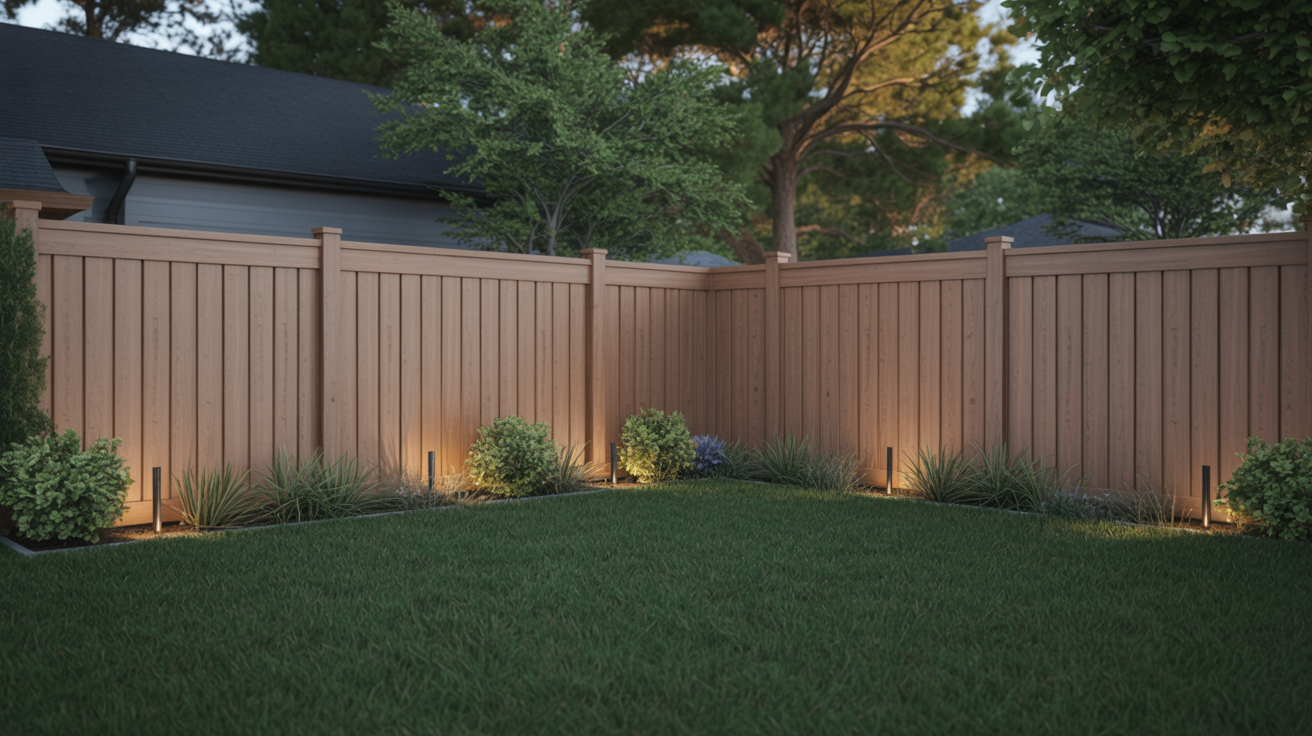
A fence is one of the most universally purchased outdoor improvements — and one of the most commonly under-specified. Most homeowners approach a fence purchase as a commodity decision: pick a material, get three quotes, choose the lowest price. The result is predictable. A wood fence that starts rotting at the post bases within five years. A vinyl fence that chalks, cracks, and fades in a climate it wasn’t spec’d for. A composite fence installed with post depths that don’t account for the local frost line, heaving a section loose by the third winter.
This fence pillar page covers what you actually need to know to make a fence decision you’ll be satisfied with for the next twenty-plus years: what composite WPC fencing is and how it compares to the alternatives, what the different fence styles and configurations accomplish functionally, what the post-setting depth and installation quality variables are that determine long-term performance, what HOA regulations mean for your project and how to navigate them, what the full installation process involves, what realistic cost looks like, and how the specific conditions across our seven service markets affect material selection and structural specifications.
The residential fence market has three dominant material categories — wood, vinyl (PVC), and composite WPC — plus aluminum and wrought iron for decorative applications. Each has legitimate use cases. The comparison matters because the upfront cost difference between materials is real, and the long-term ownership difference is equally real. Understanding both produces a decision that holds up over time.
Wood is the most widely installed fence material in the United States and the one buyers have the most reference points for. Cedar, pressure-treated pine, and redwood are the most common species — each with different natural properties that affect how they perform outdoors.
Cedar has natural oils that provide reasonable insect and rot resistance. Pressure-treated pine is chemically treated to resist rot and insects. Redwood has similar properties to cedar with slightly better natural durability. All three, however, share the fundamental limitation of any organic material installed outdoors: they require consistent maintenance to hold their appearance and structural integrity, and they deteriorate progressively regardless of maintenance once installed.
The maintenance program for a wood fence: annual inspection for rot, insect activity, and fastener movement; cleaning to remove mildew, surface deposits, and staining; staining or sealing every two to three years to prevent moisture infiltration and UV degradation. In humid markets — Naples, Orlando, San Antonio — the moisture cycle and warm temperatures create conditions where untreated wood deteriorates fast and maintained wood deteriorates eventually. In freeze-thaw markets — Romeoville, Colorado Springs, Denver — the moisture cycling through a winter season accelerates rot at post bases and surface checking across boards.
The most common wood fence failure mode is post rot at or just below the grade line — the zone where moisture is concentrated, oxygen is restricted, and the conditions for fungal decomposition are most favorable. A wood fence that looks perfectly fine from a distance may have posts that are structurally compromised at grade level, a failure that typically requires full replacement rather than repair.
Vinyl fencing is manufactured from PVC — the same polymer used in plumbing pipe — in hollow profiles that replicate the appearance of wood picket, privacy, and rail fence styles. It doesn’t rot, doesn’t require painting or staining, and resists insects entirely. For buyers who want a low-maintenance fence and are comfortable with the aesthetic limitations of PVC, vinyl is a reasonable choice.
The limitations are structural and visual. Hollow PVC profiles are not as rigid as solid composite or wood products — tall vinyl privacy panels have a characteristic flex in wind that solid-panel products don’t. In high-wind markets like the Front Range corridor in Colorado and the South Texas Hill Country edge, this flex can lead to panel deformation over time in lower-quality vinyl products. UV exposure in high-altitude and southern markets causes chalking and surface degradation in vinyl that doesn’t respond well to cleaning. Vinyl fence colors are also limited — white and tan dominate the market, with darker colors available but subject to heat absorption and dimensional expansion issues that lighter colors don’t produce.
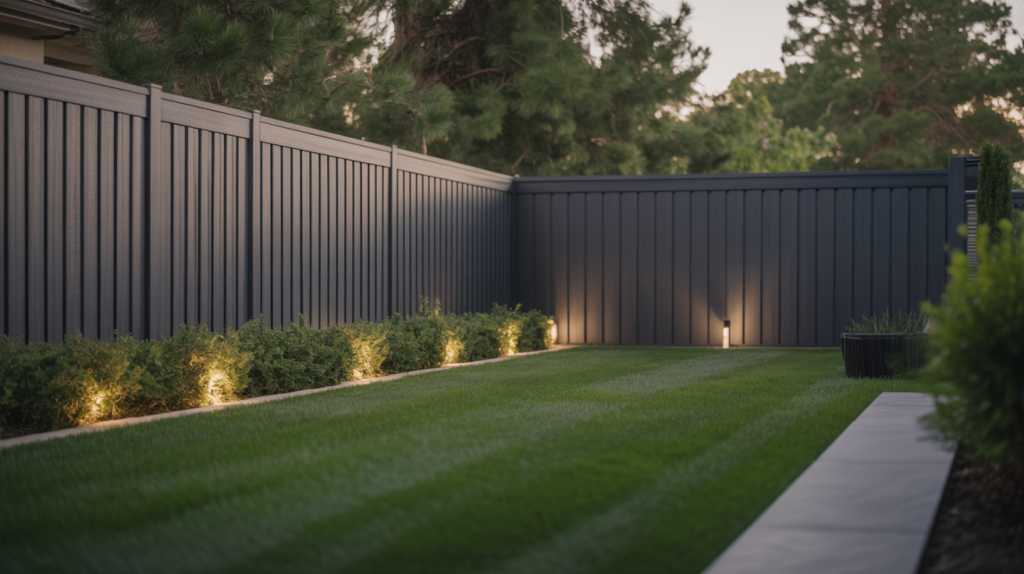
Co-extruded WPC composite is the correct baseline specification for a residential fence that needs to hold its appearance and structural performance over a 20-plus year lifespan with minimal maintenance. The same co-extrusion technology that produces Backyard Paradiso’s decking boards applies to the fence system — the composite core is encapsulated during manufacturing in a continuous polymer shell that seals the wood fiber component from moisture contact, UV exposure, and the surface degradation mechanisms that affect wood and first-generation composite products.
The performance case for composite over wood and vinyl:
Against wood: Composite doesn’t rot at the post bases, doesn’t require staining or sealing, doesn’t check or split across boards, and maintains its color and surface quality over its full lifespan without a maintenance program. The upfront cost premium over wood amortizes favorably when wood maintenance costs — labor and materials — and eventual wood replacement costs are factored into the comparison.
Against vinyl: Composite provides more structural rigidity than hollow PVC profiles — the solid composite panel construction resists wind flex and panel deformation in ways that hollow vinyl can’t match. Composite’s powder-coated color range is broader than vinyl’s standard palette. Co-extruded composite resists UV chalking more effectively than standard PVC in high-UV markets.
Against first-generation composite: The co-extrusion polymer shell eliminates the exposed wood fiber vulnerability that caused surface mold, staining, and moisture infiltration in early composite fence products. Wear and scratch resistance of co-extruded WPC is more than five times greater than first-generation mono-extruded products.
Backyard Paradiso installs co-extruded WPC composite fencing exclusively. The long-term performance advantage over wood and vinyl is significant enough that we don’t consider other materials an appropriate specification for a residential fence expected to perform well over its full service life.
The style of fence you choose determines what the installation accomplishes functionally — and what it looks like doing it. The most common mistake in fence selection is choosing a style for purely aesthetic reasons without accounting for what the fence needs to do. A decorative picket fence provides no meaningful privacy. A full privacy fence in a location where privacy isn’t the goal can make a property feel closed-in rather than defined.
Full-height solid panels with no gap between boards — the configuration that provides visual privacy from adjacent properties and the street. Privacy fence is the most common residential application in the seven markets we serve. The functional case for privacy fence is direct: it defines the outdoor living space as visually separate from the surrounding environment, which increases how much and how comfortably the space gets used.
In smaller-lot markets like Secaucus and Hudson County, privacy fence is particularly high value — the visual separation from neighboring properties at close proximity creates a sense of enclosure and intimacy in a backyard that would otherwise feel exposed. In the master-planned communities of Central Florida and Collier County, privacy fence height and style are subject to HOA architectural review, which is discussed in detail below.
Privacy fence height is typically 6 feet in residential applications. Some HOAs restrict fence height to 4 or 5 feet in certain zones. Local building codes may also impose height limits — most commonly at the front property line and side yard setbacks from the front of the house, where lower or open-style fencing is often required.
Panels with a small, consistent gap between boards — providing partial privacy, light filtration, and airflow through the fence line while maintaining the visual enclosure and property definition of a full privacy configuration. Semi-privacy fence is particularly appropriate in locations where full visual blockage isn’t required but some degree of screening is desired, and in climates and applications where airflow through the fence is a design consideration.
In high-wind areas, semi-privacy fence presents less surface area to wind loads than a solid privacy panel, which reduces the lateral force on the post-and-panel system. This is a relevant structural consideration for fence sections in exposed locations — the Front Range corridor in Colorado, the southwest-facing sections of San Antonio properties in prevailing wind exposure.
Board-and-rail fence installed in a horizontal orientation rather than the traditional vertical picket or panel. Horizontal fencing has become consistently popular in contemporary residential design over the past decade — the clean, linear aesthetic reads as modern and design-forward in a way that traditional vertical picket and rail doesn’t. In markets where the outdoor living environment is designed with a contemporary or transitional aesthetic — Denver’s Washington Park and Highlands neighborhoods, Naples’ newer master-planned communities — horizontal composite fence is frequently the style that integrates most naturally with the overall design direction.
Horizontal fence can be configured as privacy (solid horizontal panels), semi-privacy (gapped horizontal boards), or open-rail (horizontal rails with post spacing, no infill panels). The open-rail horizontal configuration works well as a property boundary definition along front yard and side yard setbacks where visual privacy isn’t the goal but a clear property edge is.
Open-style fence configurations that define a property boundary and add visual character without providing privacy. Decorative composite fence in picket or rail configurations is appropriate for front yards, garden areas, and property perimeters where visual openness is preferable to screening. The style distinction between traditional picket (vertical pointed or flat-top pickets with rail backing) and contemporary open-panel systems is largely aesthetic — both provide property definition without privacy screening.
Fencing specifically configured to meet local pool barrier requirements — typically a minimum of 4 feet in height, with self-closing and self-latching gate hardware, no horizontal members that would function as foot holds for climbing, and maximum vertical and horizontal spacing that prevents a 4-inch sphere from passing through. Pool barrier requirements are governed by state and local codes and are consistently enforced — a pool fence that doesn’t meet code is a liability and permitting issue regardless of its appearance.
Composite WPC in a semi-privacy or open-panel configuration can meet pool barrier requirements in most jurisdictions when specified and installed to the applicable code standard. Gate hardware — self-latching, self-closing, with a latch located above the reach of young children — is a specific installation requirement that goes beyond the panel system itself.
Backyard Paradiso’s composite fence system is available in three color families and multiple panel styles within each color.
Black: The most contemporary color choice — clean, modern, and visually striking as a property boundary definition. Black composite fence reads as a design element in the outdoor space rather than a utility boundary. It pairs naturally with aluminum pergola structures, contemporary paver patterns, and the landscape lighting systems that define the perimeter of the outdoor living environment at night. Note that black composite, like any dark exterior surface, absorbs heat in direct sun — a consideration for surfaces in direct contact with bare skin in high-sun markets.
Brown: The warmest-toned color option, most closely replicating the appearance of natural wood. Brown composite integrates most naturally with traditional and transitional architectural styles and with outdoor environments that include natural wood tones in decking, pergola elements, or landscape planting. Multiple brown variants are available — from lighter cedar tones to deeper walnut tones — which allows coordination with the specific wood tones already present on the property.
Gray: Cool-spectrum tones that have become consistently popular in contemporary and coastal residential design. Gray composite coordinates naturally with aluminum structures, concrete pavers, and the cool-toned material palette common in contemporary outdoor design. Multiple gray variants allow coordination from light silver-gray to dark charcoal.
Three panel profile styles are available across all three color options:
Style 1: Standard horizontal groove composite board panels — clean, flat-faced boards with a consistent surface texture. The most versatile profile, appropriate for traditional and contemporary designs.
Style 2: Composite boards with an enhanced grain texture and profile depth that more closely replicates the visual character of natural wood at closer inspection. Appropriate where the wood-like aesthetic is important to the overall design direction.
Style 3: Contemporary flat-panel profile with a clean, smooth surface character suited to modern design applications.
Every Backyard Paradiso composite fence installation includes: structural fence posts, post caps, co-extruded WPC composite boards, post covers for a finished appearance, post bases, and concrete anchor bolts. All hardware components are selected for compatibility with the composite panel system and for durability in the specific market conditions of the installation — coastal properties receive marine-appropriate hardware specifications.
Solar-powered post cap lights are available as an addition to any composite fence installation. The lights fit 2.75-inch square post tops, are constructed from UV-resistant ABS material, carry an IP44 waterproof rating for outdoor durability, and operate on solar power — eliminating wiring requirements and energy cost while providing dusk-to-dawn illumination along the fence line.
Solar post cap lights on a composite fence perimeter serve two practical functions: they define the property boundary visually after dark, and they integrate the fence into the overall outdoor lighting environment without requiring connection to the home’s electrical system.
Backyard Paradiso’s composite fence panels use a plug-in installation system — panels connect to the post infrastructure through a designed connection point rather than through face-fastened screws or nails. The insert rail system guides panels into position and the connect panel mechanism locks them in place.
This system matters for three reasons beyond installation speed:
Appearance quality. A face-fastened fence has visible fastener heads on the board faces — which are acceptable in traditional wood fence applications but don’t produce the clean finish that a premium composite installation should deliver. The plug-in system produces a fastener-free panel face that reads as designed and finished rather than installed.
Structural consistency. Panels connected through a designed rail-and-connect system maintain consistent spacing and alignment across the fence run in a way that individual face-fastened boards don’t — particularly over long fence runs where accumulated small variations in individual board placement become visible as waves or misalignment in the fence line.
Future panel serviceability. If an individual panel is damaged — impact damage, significant staining, or other isolated damage — a plug-in system allows that panel to be disconnected and replaced without disturbing the surrounding sections. A face-fastened board replacement requires removing fasteners and refinishing the fastener area of adjacent boards.
Fencing is one of the most regulated exterior improvements in HOA-governed communities — and the regulations are more specific than most homeowners expect going in. Height limits, material restrictions, color restrictions, style requirements, and setback distances from property lines all vary by community. Getting the design right before the installation starts is the difference between a fence that goes up on schedule and one that generates an HOA violation notice and a mandatory removal.
Height limits: The most universal HOA fence regulation. Rear yard privacy fence is commonly permitted to 6 feet. Side yard fence may be limited to 4 or 5 feet, particularly in the front yard setback zone where the HOA wants to maintain visual openness along the street frontage. Front yard fence, where permitted at all, is typically limited to 3 to 4 feet.
Style restrictions: Many HOAs specify or prohibit fence styles — prohibiting chain link, requiring a specific visual character that matches the community’s established aesthetic, or requiring that the “good side” of the fence face outward toward the street and neighbors. Composite fence in an appropriate style and color easily meets these requirements in virtually all communities.
Color restrictions: Some HOAs specify that fence color must match or coordinate with the home’s exterior color or approve colors from an approved palette. Composite fence’s three-color family range covers the most commonly approved residential exterior color directions.
Material restrictions: Some communities specifically prohibit chain link or certain plastic materials. Co-extruded WPC composite is accepted in all communities that permit wood and vinyl alternatives.
Setback requirements: HOA and local building code setback requirements establish minimum distances from the fence line to the property boundary — typically 6 inches to 2 feet depending on the community and the fence location.
Fences are installed on or near property lines, which means accurate knowledge of where the property line is located is a prerequisite for any fence installation. Installing a fence on a neighbor’s property — even by a few inches — creates a legal dispute that requires fence removal and reinstallation at the owner’s expense.
A survey stake or property corner monument should be located before fence installation begins. If property lines are uncertain — which is common in established neighborhoods where survey stakes have been disturbed over decades — a new survey or a review of recorded plat documentation with a licensed surveyor is the appropriate first step.
For HOA-governed properties, the architectural review committee submission is the first step — before permit application, before installation planning, and before any work begins. Submission documentation typically includes a site plan showing the proposed fence location relative to property lines and structures, a materials specification, color specification, and fence style documentation.
Backyard Paradiso is experienced with HOA fence submission processes across El Paso County, Collier County, Orange County, Bexar County, Will County, and Hudson County communities. We manage the submission documentation as part of the project scope.
What the HOA requires governs the aesthetics. What the soil and frost conditions require governs whether the fence is still standing straight in ten years. The post installation — how deep posts are set, what they’re set in, and how the installation accounts for the specific soil and frost conditions of the site — is the structural variable that determines long-term performance.
Posts set too shallow in freeze-thaw climates will heave. Frozen soil expands, and anything anchored in the freeze zone moves upward with it. Posts anchored below the frost line stay put because the concrete footing extends below the zone of movement.
Frost line depths across our service markets:
Clay soil (Will County): Clay expands when wet and contracts when dry, creating movement forces on post footings. In clay-dominant soil, oversizing the concrete footing diameter provides more bearing surface and more resistance to the lateral movement clay cycling produces.
Sandy soil (Orlando, Naples): Sandy soil drains well and provides less resistance to lateral force than compacted clay. Post footings in sandy soil benefit from a wider diameter to distribute the lateral load across more surface area.
Caliche (Bexar County): Reaching adequate post depth in caliche hardpan requires appropriate equipment and technique. Caliche also affects drainage in the footing zone — a consideration for post footing durability in this market.
Coastal conditions (Naples): Post hardware requires marine-grade or stainless steel specification in salt air proximity to prevent corrosion that would compromise the structural connection between post and ground system.
A fence without a gate to the area it encloses is either an incomplete installation or an intentional design decision. Most residential fence projects include at least one gate — typically at the side yard access point connecting the front yard to the backyard, at the access point to a pool area, or at a driveway or service entry location.
Gate post sizing: Gate posts carry more load than standard fence posts — they support the weight of the gate panel plus the dynamic load of the gate swinging. Gate posts are typically larger in cross-section and set in larger concrete footings than standard fence posts.
Hardware selection: Gate hardware — hinges, latches, and in pool barrier applications, self-closing and self-latching mechanisms — must be appropriate for the gate’s weight and use frequency. Under-sized hinges on a heavy gate sag and bind within a few years; appropriately sized hardware functions correctly through decades of use.
Pool barrier compliance: Pool-adjacent gates must meet the applicable local code requirements for self-closing action, self-latching mechanism height, and latch security. This is a life-safety requirement, not a preference.
Width: A single swing gate is practical to about 5 feet wide. Wider openings — vehicle access, equipment clearance — require a double-swing gate configuration or a sliding gate mechanism.
Every Backyard Paradiso fence installation begins with a site visit — measuring the fence run, confirming property line locations, assessing soil conditions and drainage, identifying underground utilities, reviewing HOA requirements, and discussing style, color, height, and gate placement. The assessment produces design documentation and an accurate quote.
Before any post holes are dug, underground utilities — electrical, gas, water, cable, irrigation — must be located and marked. The 811 “call before you dig” service is free, legally required in all U.S. states, and typically completes the location and marking process within two business days of a request.
Post holes are dug to the required depth using a post hole digger or hydraulic auger. Concrete is poured around the post in the hole and allowed to cure before the panel installation phase begins. Curing time typically runs 24 to 48 hours. Panels installed before the concrete is adequately cured can disturb the post position before it’s set.
Once post concrete has cured, the plug-in panel system installation proceeds — insert rails are connected to the posts, panels are fitted into the rail system and connected, and post caps are installed to finish the post tops.
Gate posts, hardware, and gate panels are installed after the fence line is complete. Hardware is adjusted for smooth operation — hinge alignment, latch strike positioning, and for self-closing pool gates, spring tension adjustment for reliable closing action.
Completed fence installation is walked with the property owner — confirming panel alignment, gate operation, post cap installation, and the overall appearance of the finished installation.
Timeline: Most residential fence installations complete in two to five days depending on linear footage, soil conditions, and the complexity of gate configurations. Post curing time is the primary schedule variable.
Fence installation cost is driven by linear footage, panel style and height, post installation requirements (frost depth, soil conditions), gate configuration, and regional labor costs.
Linear footage: Fence cost scales approximately linearly with footage. The fixed costs of a project are spread across the total footage, so cost per linear foot tends to be modestly lower for longer fence runs.
Panel height and style: Standard 6-foot privacy panels are the baseline. Taller fence sections (where permitted) and more elaborate panel styles add modest material cost.
Post installation requirements: Post installation cost in Will County and Colorado is higher than in Florida and Texas — the deeper hole depths required for frost-line compliance require more equipment time and more concrete per post.
Gate configuration: Each gate adds material cost (gate panel, heavy-duty hinges, latch hardware, larger gate posts and footings) and installation labor beyond the standard fence line cost.
Regional labor costs: Labor costs in Naples, Denver, and Secaucus are higher than in San Antonio and Romeoville, affecting the total installed cost of equivalent fence specifications.
Rough cost ranges: A professionally installed co-extruded WPC composite fence in a residential application typically runs $40 to $80 per linear foot installed, depending on style, height, market, and post requirements. Accurate cost for your specific project requires a site assessment.
Colorado Springs and Denver: Colorado’s frost line drives post depth requirements to 36 inches. Front Range wind loads are a relevant consideration for panel style selection. UV intensity at altitude requires UV-stable composite and hardware finishes across the full installation.
Naples: Collier County’s coastal properties require marine-grade or stainless steel hardware throughout. Salt air corrosion timelines for standard zinc hardware are substantially shorter in proximity to the Gulf. HOA aesthetic standards in Naples’ governed communities are among the highest in the seven-market set.
Orlando: Central Florida’s subtropical conditions favor composite’s moisture and UV resistance over wood. Orange County building code requirements for pool barrier fencing are consistently enforced. Master-planned community HOA requirements cover fence style, color, and height and require pre-approval before work begins.
San Antonio: Bexar County’s caliche soil conditions affect post hole installation — the right equipment and technique for breaking through hardpan are required to reach adequate post depth for soil stability.
Romeoville: Will County’s 42-inch frost line makes post depth the most demanding specification in the seven-market set. A fence installed with shallow posts in this market will be leaning within five years.
Secaucus: New Jersey’s 36-inch frost line drives the same post depth requirements as the Colorado markets. Hudson County’s small-lot density means fence installations are often at or very near property lines — confirming property line location before installation is more consequential in this market.
Co-extruded WPC composite fence is designed for a 25-plus year functional lifespan. The polymer shell encapsulating the composite core eliminates the rot, insect damage, UV degradation, and surface deterioration that limit wood fence lifespans.
Permit requirements for residential fencing vary by municipality. Many jurisdictions require a permit for fences above a certain height (often 6 feet) or for fences on corner lots with sight-line regulations. Pool barrier fencing almost always requires a permit and inspection. Backyard Paradiso confirms permit requirements as part of the site assessment and manages the permit process where required.
Property corners are established by survey and marked with iron pins or stakes. These markers can often be located by probing the ground at property corners with a metal detector. If survey markers can’t be located, a licensed surveyor can locate and mark property corners from recorded plat information.
The “good side” convention holds that the finished face of a fence should face outward toward the neighbor and the street. Many HOAs codify this as a requirement. Composite fence panel systems are typically designed with finished faces on both sides, which eliminates the one-sided appearance issue entirely.
Yes — there are two approaches. Stepped fence follows the grade in level sections that step down at post intervals. Racked fence follows the slope continuously. Both approaches are manageable in the installation planning stage.
Wind loads on fence panels are transmitted to the post system. A properly specified post system handles the wind loads typical for residential locations without panel failure or post movement. In high-wind exposure locations, semi-privacy panel style selection reduces the wind load the post system must resist.
Privacy fence uses solid panels with no gap between boards — it provides complete visual screening. Semi-privacy fence uses panels with a small consistent gap — it provides partial screening while allowing light and airflow through the fence line.
Backyard Paradiso installs co-extruded WPC composite fencing across all seven of our service markets. Post depth specifications, hardware selections, and HOA submission management are adapted to the conditions and requirements of each market.
Colorado Springs, CO · Denver, CO · Naples, FL · Orlando, FL · San Antonio, TX · Romeoville, IL · Secaucus, NJ
Site assessments are free, no-obligation, and the right starting point for any fence project. We’ll measure the fence run, confirm property line information, review soil and frost conditions, discuss style and color options, and produce an accurate quote based on the actual scope.
📞 (888) 497-9177
✉️ [email protected]
🌐 Request a quote