Physical Address
304 North Cardinal St.
Dorchester Center, MA 02124

What if the most expensive fence upfront could actually save you thousands in the long run? This question challenges the common belief that a lower initial price tag always means a better deal.
When you first look at quotes, the price for composite materials often causes sticker shock compared to traditional wood. However, smart homeowners are shifting their focus from mere purchase price to a more complete financial picture: the Total Cost of Ownership (TCO).
This realistic breakdown will show you why evaluating your investment over decades changes everything. The long-term value comes from dramatically reduced maintenance, exceptional durability, and a lifespan that often doubles that of wood.
The final bill for your new composite fence isn’t determined by a single factor but by a combination of several critical variables. Asking “how much does a fence cost?” is like asking “how much does a car cost?”—the answer depends entirely on the specs, size, and where you buy it. Your total fence installation cost is a custom equation unique to your property and choices.
To get a realistic budget, you need to look under the hood. Several core elements interact to create your final price. Understanding these drivers helps you communicate with contractors and interpret quotes accurately.
Here are the primary factors that directly influence your composite fence price:
An accurate quote isn’t just a per-foot material price multiplied by length. It’s a detailed assessment that weighs all these elements against your specific site conditions.
For example, a small backyard project in a low-cost region might seem affordable. But if you choose a premium composite brand and need two custom gates, the fence installation cost can climb quickly. Conversely, a long run of standard-height fence in an area with competitive labor might land at the lower end of the spectrum.
Each of these variables will be explored in detail in the following sections. By the end, you’ll know what questions to ask and how each decision impacts your bottom line. Getting a handle on these drivers is the first step to planning a successful project without budget surprises.
Your project’s scale, defined by its linear footage, is the single most influential factor in determining your composite fence cost. Contractors almost always build their estimates on a cost per linear foot. This rate combines material and installation into one clear number. You simply multiply it by your fence’s total length to get a budget baseline.
Linear footage measures the horizontal distance your fence will cover. It does not account for height. For a straight backyard line, you measure that distance. For properties with corners or curves, you add up each section. This total length is the primary input for your quote.
Here is a key nuance: the quoted rate per foot is not a constant. It often shifts based on your project’s total size. Smaller projects, usually under 100 linear feet, tend to have a higher composite fence cost per foot. Larger installations, starting around 150 linear feet, typically see a lower rate per foot.
Why does this happen? Several costs are fixed. Delivery fees, equipment setup, and a crew’s minimum charge apply whether you install 50 feet or 500 feet. On a small project, these fixed costs are divided by a small number of feet. This significantly boosts the per-foot price.
On a large project, those same fixed costs are spread over many more linear feet. Their impact on each foot diminishes. Furthermore, material suppliers may offer volume discounts for larger orders. Crews also work more efficiently on long, uninterrupted runs.
| Project Scale | Typical Linear Footage | Cost Per Foot Trend | Primary Drivers |
|---|---|---|---|
| Small | Under 100 ft | Higher | Fixed costs dominate; minimal volume discounts |
| Medium | 100–200 ft | Moderate | Balanced costs; some efficiency gains |
| Large | Over 200 ft | Lower | Costs amortized; volume discounts; high crew efficiency |
This scaling effect means you should compare per-foot quotes carefully. A higher rate for a short privacy screen is often justified. A lower rate for a long perimeter fence reflects the real economies of scale in action.
The upfront price tag of a fence material tells only part of the story. Its true cost unfolds over a decade. To make a smart choice, you need to compare pressure-treated wood, standard vinyl, and premium composite fencing on total cost of ownership.
Initial material costs vary widely. Pressure-treated wood is the budget-friendly choice upfront. Standard vinyl sits in the middle. Premium composite commands a higher initial investment. This is the first part of the composite fence pricing equation.

But material cost is just the start. Annual maintenance adds up fast. Staining, sealing, painting, and repairing take both time and money. A 10-year cost breakdown reveals the real financial picture.
| Cost Component | Pressure-Treated Wood | Standard Vinyl | Premium Composite |
|---|---|---|---|
| Initial Material Cost (per lin. ft.) | $10 – $15 | $20 – $30 | $35 – $50 |
| Estimated Annual Maintenance Cost | $2 – $4 | $0.50 – $1 | $0 – $0.25 |
| 10-Year Maintenance Total | $20 – $40 | $5 – $10 | $0 – $2.50 |
| Total 10-Year Cost | $30 – $55 | $25 – $40 | $35 – $52.50 |
Look at the total 10-year cost column. The numbers converge. Wood’s low starting point vanishes with upkeep. Vinyl’s mid-range price holds steady. Composite’s higher upfront cost is offset by near-zero maintenance.
This is the core price-to-value relationship. You pay more today for composite to save significantly tomorrow. The value lies in decades of service with no staining, no warping, and no rot.
Not all composite is created equal, which affects WPC fence price. Cheap, uncapped boards have a solid color throughout. They can fade, stain, and are less durable. Premium composites use co-extrusion technology.
Co-extrusion bonds a thick, protective polymer cap to a solid composite core. This cap resists fading, staining, and moisture. Board density also matters. Higher density means better strength and a more solid feel. You pay more for these engineered features, but they define long-term performance.
When you evaluate composite fence pricing, you are investing in future time and money savings. The initial number is important. The decade-long financial outlook is what truly determines value.
The aesthetic and functional role your fence plays—privacy, semi-privacy, or decoration—comes with different cost implications. Your decisions here directly influence how much material you need and how complex the installation will be.
Let’s start with height. A standard 6-foot tall fence is the most common choice for backyard privacy. If you need more seclusion or have specific local codes, an 8-foot height is an option.
Going taller isn’t just about adding a few extra inches of board. An 8-foot fence requires longer posts set deeper into the ground for stability. You’ll also need more composite material to cover the increased surface area. This combination of extra materials and labor pushes the composite privacy fence cost noticeably higher than a 6-foot version.
Now, consider style. Composite fencing comes in several popular profiles, each with its own price point based on material density and design.
Full Privacy Styles: These include solid vertical or horizontal board fences. They offer complete visual blockage and use the maximum amount of material per linear foot. Because of this, they typically represent the upper end of the composite privacy fence cost spectrum.
Semi-Privacy Styles: Designs like shadowbox (where boards alternate on each side of the rail) or classic picket fences create a partial visual screen. They allow some light and air to pass through.
Since these styles use less solid material than a full privacy fence, they can be a more budget-friendly way to achieve defined boundaries with a touch of style.
Decorative & Open Styles: Options like lattice tops, post-and-rail, or simple ranch rail fences are primarily for marking property lines or adding aesthetic accents. They use the least amount of composite material. Consequently, their installed cost is often the lowest among composite fence types.
To see how these choices stack up, here’s a quick look at common composite fence types and their general cost relationship:
| Fence Type | Privacy Level | Material Use | General Cost Implication |
|---|---|---|---|
| Solid Vertical/Horizontal | Full Privacy | Highest | Highest Cost |
| Shadowbox | Semi-Privacy | Moderate | Moderate to High Cost |
| Picket | Semi-Privacy | Moderate | Moderate Cost |
| Lattice (Top or Full) | Decorative/Partial | Lower | Lower to Moderate Cost |
| Post & Rail | Open Decorative | Lowest | Lowest Cost |
Remember, a taller version of any style will increase the price. Combining a 6-foot solid privacy design is the classic recipe for a higher composite privacy fence cost. Opting for a 4-foot picket or a post-and-rail style will bring the number down significantly.
Your final cost hinges on this balance between the privacy you desire and the budget you have. Think about what you really need the fence to do. That clarity will guide you to the right height and style for your project and your wallet.
Gates are more than just openings in your fence; they are complex structural elements that add significant cost to the overall project. While a standard pedestrian gate for foot traffic is a relatively straightforward component, planning for vehicle access with wide double gates introduces a new level of engineering and expense. Your choices here will directly influence your total fence installation cost.
A typical single pedestrian gate, often 3 to 4 feet wide, uses standard hinges and a latch. It’s mounted on a single post, similar to the rest of your fence line. This simplicity keeps its added cost per linear foot manageable. When you need to drive a car, truck, or equipment into your yard, however, the requirements change dramatically.
Double gates designed for vehicle access are a major cost driver. They must support much more weight and resist sagging over time, which demands a heavier-duty build. This need for robust construction translates into higher material and labor expenses specifically for the gate section of your project.
The hardware itself is a primary differentiator. Double gates require commercial-grade, heavy-duty hinges and latches. These components are built to handle the stress of frequent opening and closing while supporting the substantial weight of two wide composite panels. Standard residential hardware simply won’t suffice.
Even more critical are the post requirements. The posts that support a double gate must be significantly larger in diameter and set much deeper into the ground. It’s common practice to use 6×6 posts instead of standard 4x4s and set them in concrete-filled holes that are deeper than the frost line. This creates a rock-solid anchor to prevent the gates from drooping or misaligning. Sometimes, additional diagonal bracing is also needed behind the posts for extra support.
All these specialized materials—the massive posts, extra concrete, heavy hinges, and reinforced latches—come at a premium. The labor to install them correctly is also more intensive and skilled. Consequently, the per-linear-foot fence installation cost for a double gate section can be two to three times higher than for a standard fence run. Factoring in these requirements from the start prevents budget surprises and ensures your gate functions perfectly for years, protecting your overall fence installation cost investment.
One of the most significant variables in your quote has nothing to do with your fence design and everything to do with your location. The installed price for a composite fence isn’t a fixed national number. It’s a local calculation where labor costs often make up 40% to 60% of the total bill.
This often-overlooked factor of geography means your neighbor in the next state could pay thousands more or less for an identical project. Three main elements drive these regional differences in what contractors charge for their time and expertise.
First, prevailing wage scales, often influenced by local union rates, set a baseline for skilled labor. Second, the general cost of living in your area directly impacts what a contractor must pay their crew to live and work there. Third, simple supply and demand—contractor availability—plays a huge role.
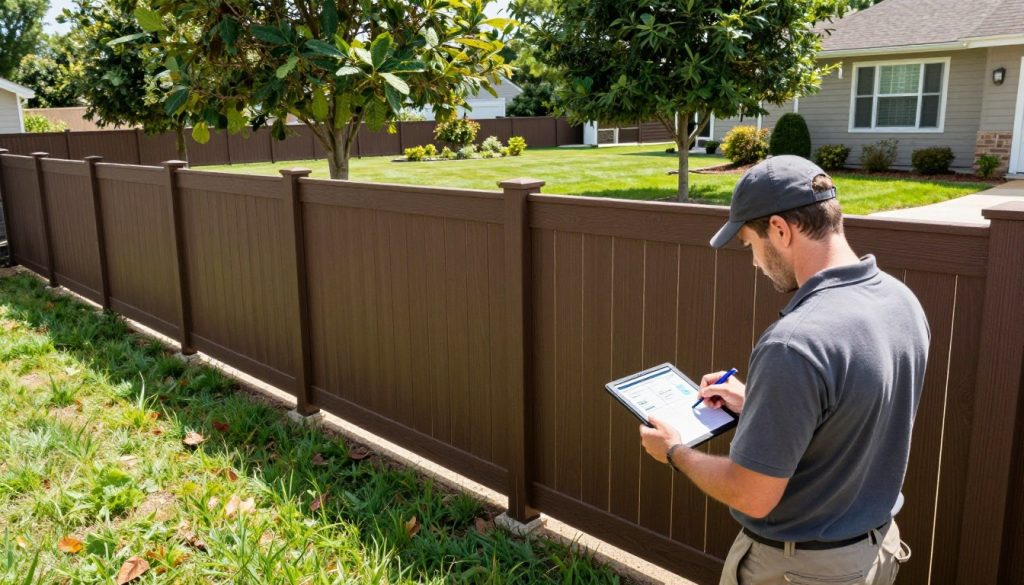
In a major metropolitan area with booming construction, demand for skilled crews is high. Contractors can command premium rates. Conversely, in a rural area with less competition and a lower cost of living, labor rates are typically more moderate.
“Homeowners are frequently surprised that a fence in San Francisco can cost double the labor of one in Sioux Falls. It’s not a markup; it’s a reflection of the local economic ecosystem for construction trades.”
To visualize how your location might impact your budget, consider the following general trends across different U.S. market types.
| Region Type | Typical Labor Cost Influence | Primary Cost Drivers |
|---|---|---|
| Major Metropolitan Area | High to Very High | Strong union presence, high cost of living, intense construction demand. |
| Suburban Area | Moderate to High | Balanced contractor availability, commuting costs for crews, solid demand. |
| Rural Area | Moderate | Limited contractor options, lower overhead costs, seasonal demand fluctuations. |
This is the core reason why generic online fence calculators provide, at best, a ballpark figure. They cannot account for the hyper-local dynamics of your labor market. A contractor in Phoenix faces different operational costs than one in Portland.
When budgeting, your most accurate step is to get multiple quotes from established, local installers. Their estimates bake in the real-world regional labor costs you will actually pay, giving you a true picture of your installed price.
Let’s translate the influencing factors into real-world numbers for a professionally installed composite privacy fence. You’ve seen how material, size, and location affect price. Now, it’s time for the bottom line.
National averages can be misleading. A single number doesn’t reflect your specific situation. Instead, a realistic range gives you a powerful budgeting tool.
This range accounts for quality differences and geographic cost variations. It sets proper expectations before you call for quotes.
For a standard 6-foot tall composite privacy fence with professional installation, a consolidated national range is $45 to $85 per linear foot. This is broader than any single estimate you might find online.
Why such a wide span? It synthesizes data from various markets. Some sources cite $35-$65 per foot for standard products. Premium capped composites and complex jobs in expensive cities drive the top end higher.
Your final composite fence cost will land somewhere inside this spectrum. The next breakdown shows exactly what moves the needle.
Your project’s specific details determine its final price. The table below contrasts the characteristics of low-end and high-end projects.
| Factor | Lower End of Cost Spectrum (~$45/ft) | Upper End of Cost Spectrum (~$85/ft) |
|---|---|---|
| Material Type | Basic, uncapped composite fence boards or panels. | Premium capped composite with enhanced weather resistance and texture. |
| Project Scale & Location | Large fence run (economies of scale) in a region with lower labor and material costs. | Small fence section or repair in a major metropolitan area with high labor rates. |
| Terrain & Layout | Flat, easily accessible yard with simple, straight lines. | Sloping, rocky, or difficult terrain requiring stepped or racked fence sections. |
| Gate Configuration | One standard, single-swing pedestrian gate. | Multiple gates, especially wide double gates needing heavier hardware and deeper posts. |
| Additional Features | Standard post caps and a simple finish. | Decorative post caps, custom colors, lighting integration, or intricate trim. |
A project at the lower end combines several cost-saving elements. You might choose a solid but basic composite material for a long run on flat land. Using a single gate keeps hardware simple.
The upper end reflects a desire for the highest durability and aesthetics. Premium capped composites resist fading and staining better. Complex installations and add-ons require more skilled labor and specialized materials.
Understanding this spectrum helps you communicate priorities with contractors. It turns a vague budget into a focused plan.
While online calculators provide a starting point, your actual project cost is determined by the unique conditions of your yard. These digital tools use generic averages for material and labor. They cannot account for the specific challenges or advantages your property presents.
Relying on them for your final budget is a common pitfall. A generic estimate might look appealing, but it often misses critical details that affect both price and installation. As one industry source notes, “the difference between an estimate and a quote is the difference between guessing and knowing.”
This is why a professional site assessment is non-negotiable for an accurate quote. An experienced installer visits your home to evaluate variables that online forms simply can’t see. This on-the-ground inspection is what locks in your final price.
During a site assessment, the installer will examine several key factors:
Each of these elements can only be properly judged in person. They have a direct and substantial impact on your final price. A quote based on a real site assessment protects you from unexpected surprises and change orders later.
To move from a rough online guess to a firm, dependable price for your composite fence, you need a professional evaluation. For a detailed assessment and a transparent quote tailored to your property, contact our experts at (888) 497-9177. Let’s turn your estimate into a solid plan.
Many homeowners have similar questions when evaluating composite fence pricing for their property.
Is composite fencing more expensive than wood long-term?
While the initial price is higher, the total cost of ownership is often lower. You avoid the recurring expenses of staining, sealing, and replacing rotten wood panels.
What is the real maintenance cost?
It is effectively zero beyond occasional cleaning with soap and water. This saves you significant time and money over decades.
Does it increase property value?
A composite fence boosts curb appeal with its consistent, clean look. Many brands offer transferable warranties, which are attractive to future buyers.
What if a panel gets damaged?
Individual panels or sections can often be replaced without rebuilding the entire fence. This makes repairs more manageable and cost-effective.
For a precise figure on how much does a fence cost for your specific project, contact our experts at (888) 497-9177 for a detailed site assessment and quote.