Physical Address
304 North Cardinal St.
Dorchester Center, MA 02124

What if you didn’t have to choose between a driveway that looks stunning and one that can actually handle the weight of your family’s cars, year after year?
For centuries, one specific layout has answered this challenge. The herringbone paver design is a timeless, classic choice. Its visual appeal is matched by legendary durability.
This interlocking, zigzag design isn’t new. It has roots in ancient Roman engineering. They used it for roads built to withstand incredibly heavy loads.
That same structural genius is available for your home today. It creates an installation that is both beautiful and incredibly strong. Let’s explore why this option stands above the rest.
Ready to transform your curb appeal? Contact us at (888) 497-9177 for a free quote on your herringbone driveway project.
Unlike decorative layouts, the herringbone design solves a fundamental engineering challenge posed by turning wheels. When a vehicle moves, especially when turning or braking, it creates powerful lateral forces. These forces push against the pavers, trying to shove them sideways. Most patterns have a weakness: long, straight seams.
A herringbone interlock is powerful because it eliminates these weak lines. The pavers are set at alternating 45-degree angles, creating a continuous zigzag. This means every joint is short and interrupted by the next paver. Industry standards are clear on this point.
Industry experts state that a fully interlocked herringbone pattern should be used for vehicular areas whenever possible. Its main strength is the lack of straight joints (no joint longer than 300mm), which offers the greatest degree of interlock, preventing creeping and rutting.
Think of it like a puzzle. A puzzle with long, straight edges is easier to pull apart. A puzzle with all interlocking, irregular pieces locks together tightly. Your driveway paver pattern works the same way.
The short, angled joints create a unified grid. When weight presses down from a car tire, that force spreads out through the network of connected pavers. The lateral push from a turning wheel meets resistance at every angle. This stops individual units from shifting or spreading apart, a problem known as “creeping.”
To see why herringbone is structurally superior, compare its joint characteristics to other common layouts.
| Paver Pattern | Maximum Joint Length | Degree of Interlock | Suitability for Driveways |
|---|---|---|---|
| Herringbone (45°) | Less than 300mm | Full | Excellent |
| Running Bond | Long, continuous lines | Partial | Good |
| 90-Degree Grid | Long in both directions | Minimal | Fair |
The table shows the direct link between short joints and strong interlock. Long joints are stress points. Over years of traffic, these stress points can fail, leading to ruts and an uneven surface. The herringbone pattern’s design avoids this entirely.
The real-world benefit for you is a driveway that stays flat and stable for decades. You won’t see pavers slowly migrating to create gaps or dips. You get a surface that resists rutting from heavy vehicles and repeated tire tracks. This structural integrity is why herringbone is the professional’s choice for high-stress areas.
Choosing the right pattern is a key part of a durable installation. For a professional assessment of your driveway’s specific structural needs, call (888) 497-9177.
Your driveway faces constant stress from vehicle weight and movement, which the herringbone pattern is uniquely designed to handle. This isn’t about looks alone. It’s about physics. The famous zig-zag layout creates a mechanical bond between pavers that is far stronger than simpler patterns. This bond is called interlock.
Interlock is what stops individual pavers from shifting, rocking, or sinking under pressure. For a lasting, stable surface, understanding this herringbone interlock is key.
Every paver in a herringbone layout is set at a precise 45-degree angle to the driveway’s edge. This specific angle is not random. It is the optimal position for creating a tight, web-like structure.
Think of it like a woven basket. Each paver is braced by its neighbors on two sides. When a force tries to push one paver sideways, that force is immediately transferred to the pavers touching it. Those pavers, also locked at 45 degrees, transfer the force again.
This creates exceptional lateral resistance. Lateral means side-to-side movement. In a running bond pattern, pavers are lined up in rows. A sideways push can slide a whole row. In herringbone, that same push gets absorbed and dissipated across the entire grid.
Proper installation is crucial. Tips for laying a 45-degree herringbone pattern emphasize tight joints and consistent spacing. This ensures every paver makes full contact, maximizing the interlocking effect of this superior driveway paver pattern.
Cars and trucks generate two main types of force on your pavers. The herringbone interlock is engineered to manage both.
First is vertical load. This is the sheer weight of your vehicle pressing down. Herringbone spreads this load over a wider area of the base below. This prevents concentrated pressure points that can cause settling.
The second, more challenging force is shear. Shear force happens when your tires turn, brake, or accelerate. The friction between the tire and the paver tries to shove the pavers horizontally. This is the primary cause of shifting and misalignment in weaker patterns.
The interlocking 45-degree angles directly combat this shear force. The web structure locks each unit in place, so the force from a turning wheel is resisted by multiple pavers at once. The table below breaks down these forces and how herringbone responds.
| Vehicle-Generated Force | Effect on Pavers | How Herringbone Interlock Counters It |
|---|---|---|
| Vertical Load (Weight) | Pushes pavers down into the base. | Distributes weight across a network of pavers, reducing point load on the base. |
| Lateral Shear (Turning/Braking) | Tries to slide pavers sideways. | Angled pavers brace each other, converting shear force into compressive force within the grid. |
| Vibrational Stress | Can loosen pavers over time. | Tight, multi-directional interlock minimizes individual paver movement and settling. |
When you drive onto a herringbone driveway, the entire pattern works as a unified, rigid mat. This shared load capacity is why it resists movement from shifting tires and heavy loads year after year. The initial precision in creating the interlock pays off with long-term stability you can see and feel.
Two of the most common paver layouts for driveways are herringbone and running bond, but their structural behaviors under load are worlds apart. While both can look attractive when first installed, only one is engineered to handle the constant stress from your vehicles. This comparison is essential for choosing the best driveway pattern for lasting performance.
Running bond, also called stretcher bond, arranges pavers in long, straight rows with continuous joints running the length of the driveway. This pattern is popular for walkways and patios. For foot traffic, it works perfectly fine. However, when you drive a car over it daily, a critical weakness is exposed.
The problem with running bond lies in its long, uninterrupted joint lines. Think of these joints as long, straight seams. When your car’s tire rolls over the surface, it creates lateral forces—pushing sideways. The long joints act like slides, allowing pavers to gradually creep and shift past each other.
This lateral movement is subtle at first. Over time, it leads to visible problems. You might notice pavers spreading apart, creating gaps. The surface can become uneven, forming ruts where tires most frequently travel. The pattern, once neat and straight, begins to look wavy and misaligned.
In contrast, a herringbone driveway is built like a woven fabric. Its zigzag pattern creates interrupted joints. No single joint runs in a straight line for more than the length of one paver. When lateral force is applied, each paver is locked in place by its neighbors at an angle. The force is dissipated across the entire grid, preventing any single paver from sliding.
| Feature | Herringbone Pattern | Running Bond Pattern |
|---|---|---|
| Joint Structure | Interrupted, zigzag joints | Long, continuous straight joints |
| Lateral Resistance | Extremely High | Low |
| Primary Use Case | Driveways, high-traffic areas | Walkways, patios, light traffic |
| Long-Term Stability | Maintains alignment for decades | Prone to creeping and spreading |
| Best For | The best driveway pattern for vehicles | Pedestrian areas only |
The theoretical weakness of running bond becomes a practical issue over the years. Under regular use from cars and trucks, a running bond driveway often shows clear signs of distress within a decade to fifteen years.
Common issues include visible gaps between pavers, a wavy surface texture, and depressions where tires track. Repairing this usually means lifting and re-compacting a large section, which is costly.
A properly installed herringbone driveway tells a different story. After the same 10 to 15 years, it should still look remarkably tight and even. The surface remains flat, with no rutting or significant misalignment. The initial investment in a more complex pattern pays off with dramatically reduced maintenance and a pristine appearance that lasts.
Choosing the right pattern from the start saves you from future headaches and expense. For a driveway that must bear vehicular loads, the structural evidence strongly points to one winner.
Beyond choosing herringbone, you must decide on the orientation—45-degree or 90-degree—which impacts how your driveway handles stress and looks. Both layouts use the classic interlocking zigzag, but the angle at which the pavers are set changes everything from performance to personality.
For pure structural performance on a driveway, the 45-degree herringbone orientation is the champion. This angle positions each paver to resist pushing forces from virtually any direction. Think about how a car turns and brakes. These actions create lateral and diagonal stresses. The 45-degree pattern locks itself against these forces most effectively.
The 90-degree herringbone pattern is also exceptionally strong. Its primary strength runs parallel and perpendicular to the direction of travel. This makes it an excellent choice for long, straight driveways where vehicles move mostly in one line. Many installers favor it for its straightforward layout.
“In my 20 years of installing paver driveways, I always recommend the 45-degree herringbone for homes with tight turnarounds or frequent guest parking. The multidirectional lock it provides is unmatched for preventing shifting,”
The practical steps for laying each pattern highlight their differences:
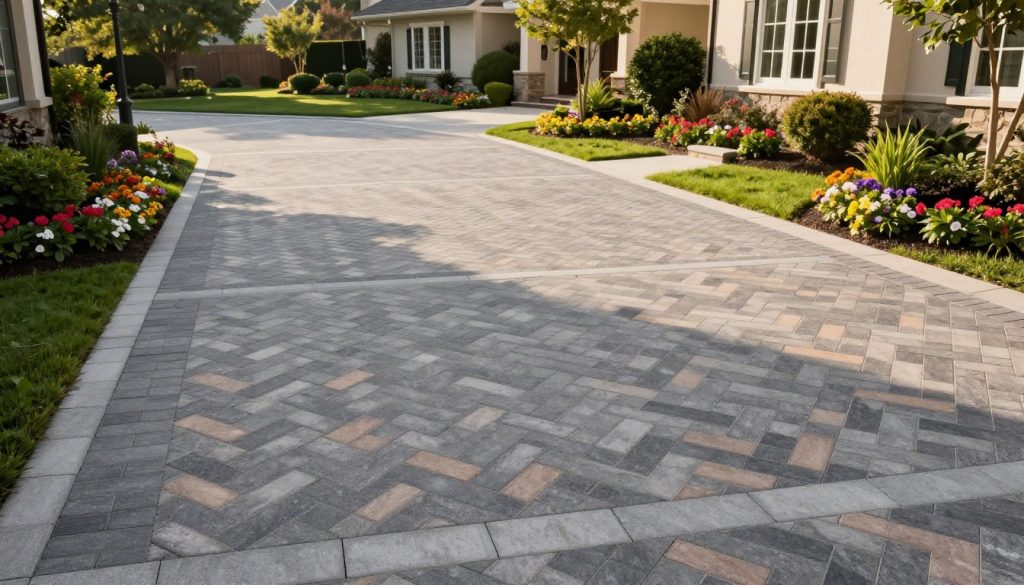
The visual impact of your paver driveway design is profoundly different between these two angles. A 45-degree herringbone pattern creates a dynamic, energetic feel. The zigzag lines appear to flow diagonally across the space, which can make a wide driveway feel more active and a narrow one feel broader.
In contrast, the 90-degree herringbone presents a bolder, more geometric statement. The pattern forms a series of right-angle turns, creating a strong, orderly grid-like effect. This look often complements modern or traditional architectural styles with clean lines.
Your choice can depend on the driveway’s shape. A 45-degree pattern can help disguise irregularities or direct the eye beautifully on a curved approach. A 90-degree pattern might be the perfect frame for a rectangular garage front.
| Orientation | Structural Performance | Visual Character | Best For |
|---|---|---|---|
| 45-Degree Herringbone | Superior multidirectional interlock; handles turning/braking forces best. | Dynamic, energetic, diagonal flow; can make spaces appear larger. | Driveways with curves, turnarounds, or high lateral stress. |
| 90-Degree Herringbone | Excellent linear strength; very stable for straight-in, straight-out traffic. | Bold, geometric, orderly; clean right-angle zigzag. | Long straight driveways, modern home styles, simpler installation. |
| Key Consideration | 45-degree offers the highest overall stability. | 45-degree is more visually complex; 90-degree is more structured. | Balance your performance needs with your aesthetic preference. |
Ultimately, for a herringbone paver driveway where longevity is the top priority, the 45-degree orientation is the technical winner. However, the strong performance and striking look of the 90-degree pattern make it a completely valid and popular choice. Your final decision blends engineering with art.
The success of a herringbone driveway installation depends heavily on the dimensional consistency of the pavers. Your choice of material directly influences how well the pattern locks together and how long it lasts under daily vehicle loads.
While the herringbone pattern provides superior mechanical interlock, this strength can only be fully realized with pavers that are uniform in size and shape. Even slight variations in width or thickness can create uneven gaps, weakening the entire system.
This makes material selection a critical step in your paver driveway design process. You need units that are engineered for precision.
Why is consistency so vital for a herringbone paver layout? The pattern relies on each unit fitting tightly against its neighbors at precise 45-degree angles. If pavers are irregular, the joints become inconsistent, compromising the interlock and allowing movement.
Manufactured concrete pavers are the top recommendation for this reason. Leading brands like Unilock engineer products specifically for complex patterns. Their Copthorne and Mattoni lines, for example, are known for narrow profiles and exceptional dimensional tolerance.
This means every paver is virtually identical, allowing for tight, even joints throughout the entire driveway field. The durability of these concrete units also ensures they can handle freeze-thaw cycles and heavy weights without cracking.
Granite cobblestones are another excellent, high-end option. Milled granite blocks offer incredible durability and a timeless look. Their machine-cut consistency makes them suitable for a precise herringbone installation, though they often come at a higher cost.
You should generally avoid using irregular, hand-cut, or natural flagstone for the main field of a herringbone driveway. The varying sizes make the pattern extremely difficult to execute correctly. The resulting loose fit will undermine the structural benefits.
Such materials can, however, be used effectively as a decorative border. This lets you add visual interest without sacrificing the critical interlock in the primary driving area. For the core of your paver driveway design, stick with dimensionally consistent concrete or granite.
Investing in the right materials from the start ensures your herringbone paver driveway is not only beautiful but built to last for decades.
The intricate beauty of a herringbone paver pattern comes with a notable increase in installation complexity. While the final result is a stunning and supremely stable surface, getting there requires more skill and patience than laying a simple running bond.
You must plan for a significantly higher number of precise cuts. Unlike running bond, where many perimeter pieces are simple rectangles, the 45-degree or 90-degree angles of a herringbone design create numerous trapezoidal and triangular cut pieces along the edges.

Each of these cuts must be exact. Even a slight miscalculation can break the visual flow and, more importantly, compromise the interlocking strength that makes this driveway paver pattern so effective. The layout phase is critical, demanding meticulous string lines and constant checks for square.
Angle consistency is non-negotiable. Every paver must be set at the same 45 or 90-degree orientation relative to the border. Any deviation creates a domino effect, pushing subsequent rows out of alignment and creating gaps. This level of precision separates a professional-grade installation from an amateur attempt.
While a highly skilled and patient DIYer can theoretically install a herringbone driveway, the margin for error is slim. The time, specialized tools, and experience needed are substantial. A poor installation can undermine the superior structural benefits of the pattern itself, leading to shifting, settling, and an uneven surface years before you should see such issues.
For this reason, consulting a professional installer is strongly recommended. An experienced contractor brings the necessary tools, knowledge of substrate preparation, and an eye for the precise craftsmanship this pattern demands. They ensure the investment in both materials and design delivers its full, long-term value.
If you are considering a herringbone driveway and want to ensure it’s installed correctly, we can connect you with a qualified contractor. Contact us at (888) 497-9177 to be connected with an authorized professional in your area. This simple step can save you significant time, effort, and potential frustration, guaranteeing your beautiful and durable driveway paver pattern performs flawlessly for decades.
Investing in a herringbone paver driveway requires a closer look at the upfront costs versus the long-term structural benefits. You are not just paying for a pattern. You are funding an engineering solution for your home’s entrance.
The initial price for a herringbone driveway is typically 15% to 30% higher than a standard running bond installation. This premium stems from three main factors:
View this cost difference as an investment, not an expense. The structural value it provides pays back over decades. A properly installed herringbone grid resists shifting and settling far better than other patterns.
This means you avoid common and costly driveway problems. You won’t need frequent re-leveling of sunken pavers. Joint sand stays in place longer, reducing the need for re-sanding. The surface remains flat and stable, preserving both its function and your home’s curb appeal.
The table below breaks down the cost-value equation clearly:
| Factor | Cost Impact | Long-Term Value Benefit |
|---|---|---|
| Pattern Complexity | Higher labor hours increase installation cost. | Superior interlock prevents paver movement, eliminating future repair labor. |
| Material Cutting | Leads to 5-10% more material waste. | Precise fit creates a monolithic surface that handles vehicle loads without failure. |
| Installer Expertise | Requires a premium contractor, often at a higher rate. | Expert installation ensures decades of performance with near-zero maintenance. |
| Overall Investment | Higher total upfront project cost. | Protects property value and delivers permanent durability, offering a much lower lifetime cost. |
When you add up the avoided maintenance, repairs, and early replacement, the best driveway pattern often proves to be the most economical over 20 years. The herringbone layout is a one-time solution.
For a detailed quote on a herringbone driveway that breaks down this value proposition item by item, call our experts at (888) 497-9177. We can provide a transparent cost analysis tailored to your specific project.
Choosing herringbone is a decision for permanence. You pay more today to save significantly tomorrow. This investment locks in the beauty and utility of your driveway for the long haul, making it a wise financial choice for any homeowner.
You might have questions about choosing a herringbone driveway pattern. These answers cover the essentials.
Is a herringbone pattern really stronger for driveways? Yes. The 45-degree angular orientation creates a superior interlock. This design provides excellent lateral resistance against the forces from vehicle wheels.
Can I use any paver for a herringbone design? For best results, use dimensionally consistent units. Concrete pavers from brands like Belgard or Techo-Bloc, and natural stone like granite, work best. Irregular shapes make the precise herringbone paver layout difficult.
Is a herringbone installation much harder? It requires more precision than a running bond. Expect more cuts and careful planning. A professional installer ensures the pattern’s integrity.
Is the higher cost of a herringbone driveway worth it? The investment pays off in long-term performance. A proper driveway paver pattern like herringbone resists shifting and settling for decades. It also adds significant curb appeal.
Have more questions about your project? Our experts are ready to help. Contact us at (888) 497-9177.